Thermal Label Materials: Which Roll to Order for Each Job
A label printer will print onto the wrong material without complaining. The failure turns up later: a courier label gone grey in a warm van, a freezer carton with the label lifting at one corner, a shelf label smeared where a picker's glove rubbed across it. Those are rarely printer faults. They are thermal label materials picked on size and price alone, and the correction costs less than the reprint and the redelivery.
This guide matches label stock to the job: direct thermal or thermal transfer, paper or synthetic, which adhesive, and which core fits your printer. Part numbers and roll counts below are stock we hold.
Which label should you order for your job?
| Your situation | Order this |
|---|---|
| Courier parcels for Omniva, DPD, DHL | 100 x 150 mm direct thermal paper. KK01673 (360 per roll, 9.28 EUR) or KK000270 (1000 per roll, 76 mm core). See courier shipping labels |
| Retail price and barcode labels, sold within weeks | 50 x 30 mm direct thermal paper, KK001109, 1000 per roll, 3.72 EUR. See retail barcode labels |
| Small items, cable ends, jewellery tags | 32 x 20 mm polypropylene, KK010323, 2000 per roll. See price tag and small barcode labels |
| Carton and shelf-edge labels kept for months | 100 x 60 mm thermal transfer paper, KK070136, 1000 per roll, 10.68 EUR, plus a ribbon. See carton and warehouse shelf labels |
| Damp, oily or washed-down surfaces | 100 x 50 mm polypropylene, KK000974, 1000 per roll, 11.14 EUR |
| Pallet and SSCC labels | 100 x 100 mm. KK000408 direct thermal or KK000202 thermal transfer, 500 per roll. See pallet and carton labels |
| Asset tags that survive cleaning and solvents | 50 x 30 mm silver matte polyester, KK001794, 1000 per roll |
| Tags with no adhesive, hung or inserted | 50 x 37 mm thermal card tag, KK000318, 1000 per roll, black mark sensing |
Direct thermal or thermal transfer: which one does your job need?
This is the decision that sets everything else. Direct thermal uses heat-sensitive paper and no ribbon. Thermal transfer uses a ribbon that melts pigment onto the facestock, which means two stock items instead of one, and a print that lasts.
The honest rule is about how long the label has to stay readable, and what it will meet in between. Direct thermal is the right, cheaper answer for anything consumed inside roughly a year indoors. Zebra rates its Z-Select 2000D coated thermal paper (part 880199-025D) for indoor use up to one year, with a service range of -40 to 50 degrees C. What kills a direct thermal label early is not age, it is heat, sunlight, friction and solvents. A parcel label on a dashboard in July will darken. A label rubbed repeatedly by a conveyor guide will scuff.
Thermal transfer earns its ribbon cost when the label is read after months in a warehouse, printed on a synthetic face, or exposed to sun, oil or cleaning chemicals. If your labels are picked and scanned within days, paying for ribbons is waste.
| Question | Direct thermal | Thermal transfer |
|---|---|---|
| Ribbon needed | No | Yes, matched to the face material |
| Stock lines to manage | One | Two, and they must match |
| Typical readable life indoors | Up to about 1 year | Several years |
| Sunlight and heat | Darkens and fades | Stable |
| Friction and solvents | Scuffs, can smear | Resistant, resin best |
| Prints on synthetics | Rarely | Yes |
| Best for | Courier parcels, price labels, kitchen and picking | Asset tags, archive cartons, outdoor, chemical |
Paper or synthetic: what actually fails in the Baltic and Finnish trade
Paper facestock is the default and it is fine for most retail and courier work. It fails in three predictable ways: it absorbs water and goes limp, it tears when someone tries to peel and reposition it, and it wrinkles on a curved or textured surface such as corrugated board that has been stored damp.
Synthetic facestock, sold here as foil or synthetic labels, solves those. There are two that matter:
Polypropylene (PP) is the everyday synthetic. It shrugs off condensation, splashes and handling, and it conforms reasonably to curves. Use it for cold rooms, fresh produce crates, anything that leaves a chiller into a warm room and sweats. The 100 x 50 mm white PP roll, KK000974, is the one most warehouses standardise on. A 100 x 100 mm PP roll, KK001451, covers pallet work.
Polyester (PET) is the durable one. It resists solvents, cleaning agents and higher temperatures, and it does not stretch, which matters for asset tags nobody should be able to peel off cleanly. Silver matte polyester, such as KK001794 in 50 x 30 mm, is the standard look for equipment and IT asset labels.
The trade-off is plain: a synthetic roll costs roughly two to four times a paper roll of the same size. KK000974 in polypropylene is 11.14 EUR per 1000 against 6.96 EUR per 1000 for the paper equivalent KK019227. If the label is read once at a parcel machine and binned, pay for paper.
Which adhesive, and why your loading bay temperature decides it
Adhesive is the specification most buyers never look at, and it causes more label failures in this region than any print setting. Three things matter.
Acrylic is the general-purpose permanent adhesive on most rolls we stock. It holds across a wide temperature range, resists UV and chemicals reasonably, and keeps grip over time. It is slower to build initial tack, so it likes a clean, dry, flat surface.
Rubber adhesive grabs faster and harder, which is why it wins on recycled corrugated board, textured plastics and anything cold. Zebra specifies permanent rubber adhesive on Z-Select 2000D for exactly that reason. KK001260 is the same 50 x 30 mm retail size on rubber glue if acrylic labels keep lifting on your cartons.
Removable adhesive exists for promotional pricing and temporary shelf marking, where the label must come off without residue. KK069957 in 80 x 50 mm is the semi-gloss removable version. Do not use removable stock for anything that has to survive a lorry.
Now the part that catches people out every winter. A service temperature range and an application temperature are two different figures. Z-Select 2000D serves down to -40 degrees C, but its minimum application temperature is 0 degrees C. That means you may label a carton in a warm room and then freeze it, but you may not apply that same label to a box already sitting at -20 degrees C in a cold store and expect it to hold. Labels applied cold need a freezer grade adhesive specified for cold application. If you are labelling inside a chilled or frozen area, or on a loading bay in January, say so when you order and we will match the adhesive rather than the size.
Core size, wind direction and roll diameter: the specs that stop a roll fitting
A correct label on the wrong roll format still will not print. Check three numbers against your printer before you order a pallet of media.
| Spec | What you will see | Why it matters |
|---|---|---|
| Core diameter | 25.4 mm (1 inch), 40 mm, 76 mm (3 inch) | Desktop printers take 25.4 mm and 40 mm cores. Industrial printers usually need 76 mm. A 76 mm core will not fit a desktop spindle |
| Roll outer diameter | Commonly 127 mm on desktop rolls | Desktop printers cap out around 127 mm. Larger rolls need an external media holder |
| Wind direction | Outer wind or inner wind | Labels face out or in. Get it wrong and the printer feeds blank liner |
| Gap or black mark | Die-cut gap, or a printed black mark | The sensor must be set to match. Card tags such as KK000318 use a black mark, not a gap |
A 76 mm core roll holds several times more labels, so an industrial printer reloads far less often. If you print thousands of parcel labels a day on a desktop unit and stop to reload every hour, the media format is telling you the printer is undersized.
Which ribbon pairs with which facestock?
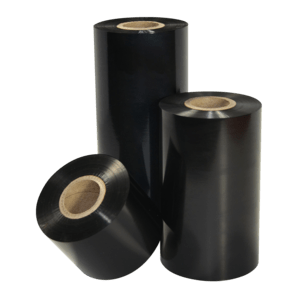
If you chose thermal transfer, the ribbon must match the face material, not just the width. Wax suits coated paper and is the cheapest option for carton and shelf labels. Wax resin covers semi-gloss paper and light synthetic work where some scuff resistance is wanted. Full resin is for polyester and for anything meeting solvents, steam or sustained heat. Printing a wax ribbon onto polyester produces a label that wipes off with a thumb, which is the single most common consumable mistake we see. Ribbon width should be equal to or slightly wider than the label, and the roll must match your printer for core size and ink side, coated side in or coated side out. Browse thermal transfer ribbons by printer and width.
Common questions
Can I use direct thermal labels in a thermal transfer printer? Yes. Set the printer to direct thermal mode and remove the ribbon. Leaving the ribbon loaded in transfer mode while running thermal paper wastes ribbon and can cause sticking.
Why has my printed label faded after a few weeks? Almost always direct thermal stock exposed to heat, sunlight or friction. If the label lives in a window, a vehicle or a warm kitchen, move that job to thermal transfer.
Do I need 300 dpi for small labels? Only when you are printing small 2D codes, fine text under about 6 point, or labels narrower than roughly 25 mm. For 100 x 150 mm courier labels, 203 dpi is correct and faster.
My labels peel off frozen cartons. What do I change? The adhesive, not the material. Check whether labels are being applied below 0 degrees C. If they are, you need a cold application freezer adhesive, and moving to a synthetic face will also stop the paper wicking moisture.
Are these labels suitable for food contact? Some are. Zebra states that Z-Select 2000D complies with EU and FDA rules for dry and moist non-fatty foodstuffs. Materials vary, so confirm the specific stock before using it on primary food packaging.
Ordering the right roll
Start with the life of the label, not the size. If it is read and thrown away within weeks indoors, direct thermal paper on acrylic adhesive is the cheapest correct answer. If it must last, go outdoors, or meet moisture, oil or cleaning agents, move to synthetic and thermal transfer and accept the ribbon. Then check core, diameter and wind against your machine. Our full range of thermal labels and tags lists material, adhesive, core and roll count on each product, with matching ribbons for transfer work. If the printer itself is the limit, compare desktop and industrial models in label printers. Send us the surface, the temperature at the moment of application and the required life, and we will match the stock rather than guess from a size.
Tags:
Previous
Rugged Tablets and Laptops: Which Model for Which Job
Next
Barcode Scanner Setup for Erply, Directo and Loyverse