Rugged Tablets and Laptops: Which Model for Which Job
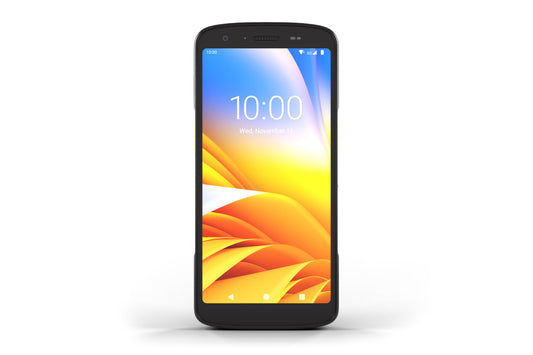
Most people who ask us for a rugged tablet have one of two pictures in their head, and both are usually wrong. Either they want a consumer tablet in a thick rubber case, or they have been quoted a fully rugged Windows machine at over four thousand euros and cannot see what justifies it. Almost all the useful hardware sits between those two points. What decides where you belong is not brand loyalty: it is whether your software runs on Android or Windows, whether the device lives in a hand or in a vehicle mount, and how cold it gets where the work happens.
Below is the shortlist we quote from, sorted by job and by price tier, with real part numbers and the specs we can stand behind.
Which rugged tablet or laptop should you order for your job?
| Your situation | Order this | Approximate price |
|---|---|---|
| Indoor picking, receiving and stock counts on an Android app | Zebra ET401 8 inch (ET4010B-001C1B0P-A6) | 764 EUR |
| Delivery rounds, proof of delivery, parcel scanning | Honeywell ScanPal EDA10A (EDA10A-00BE91N21RK) | 1 108 EUR |
| Outdoor crews on gravel and mud, Android, hard drops | Getac ZX80 (Z8A7FHGB1DXC) | 960 EUR |
| Field service engineer running Windows diagnostic software from a van | Getac F110 G7 (FTA164JI1DXX) | 2 514 EUR |
| Permanently vehicle mounted, gloves on, screen in direct sun | Getac UX10 G5 (UW1764VIX1XX) or Getac F120 (FW1764WI1DXX) | 2 891 to 2 951 EUR |
| Tablet that must turn into a laptop for paperwork | Getac K120 G3 (KTA164V8XKXX) or Panasonic TOUGHBOOK G2 mk3 (FZ-G2NBMBGB4) | 2 650 to 3 216 EUR |
| Office engineer who goes on site two days a week | Getac S510 (SX176A34SDXX) or Panasonic TOUGHBOOK 55 (FZ-55G6601BE) | 2 243 to 2 642 EUR |
| Serial ports, card readers, all day outdoors, genuine abuse | Panasonic TOUGHBOOK 40 (FZ-40FZ004B4) | 4 318 EUR |
Prices are catalogue list prices at the time of writing and move with configuration and stock.
Is Android or Windows the right platform for this work?
This single choice sets your budget, because an Android rugged tablet and a Windows one are separated by roughly 1 500 euros per seat. Android is right when the work is one purpose-built application: a warehouse client, a delivery app, an inspection form, a stock count. Those devices are light, they have a proper scan engine option, they charge in a cradle, and they are managed with the same mobile device management tool as your handheld terminals.
Windows is right when the software will not move. A vendor diagnostic tool that only ships as a Windows executable, a CAD viewer, a VPN client tied to domain join, a USB or serial instrument with Windows-only drivers: none of these are fixed by wishing. If that describes your technicians, buy Windows and stop shopping the Android price tier.
The trade-off runs the other way too. Plenty of warehouses buy Windows tablets out of habit, then run a browser on them all day. If your ERP has a real Android client, you are paying two and a half times over for a Start menu nobody opens.
One detail that people miss on the Android side is which release the device ships on. The Getac ZX80 ships on Android 15. The Honeywell ScanPal EDA10A ships on Android 12 with a stated upgrade path to Android 14. Buying a device that launches two releases behind shortens the security life of your fleet before it leaves the box, and that is a real cost when the hardware is meant to last five years.
What do IP66, IP65 and MIL-STD-810H actually promise?
These are the two specs most often quoted and least often understood. The IP rating is a sealing test with a defined procedure. MIL-STD-810H is not a pass mark at all: it is a catalogue of test methods, and a manufacturer states which methods were run and at what level.
| Rating | Tested against | What it does not cover |
|---|---|---|
| IP53 | Limited dust ingress, water spray up to 60 degrees from vertical | Rain on an open site, washdown, dust storms behind a forklift |
| IP65 | Dust tight, low pressure water jets from any direction | Pressure washing, immersion |
| IP66 | Dust tight, powerful water jets from any direction | Immersion, including a drop into a puddle face down |
| IP67 | Dust tight, immersion to 1 metre for 30 minutes | Sustained pressure washing at close range |
On the drop figure, the questions to ask are the height, the number of drops, the surface, and whether the device was powered on during the test. A 1.8 metre operating drop to concrete is a very different claim from a 1.2 metre drop achieved with an optional protective frame fitted. The Zebra ET401 is rated for 1.2 metre multiple drops bare and 1.5 metres with the optional rugged frame, so the frame is not an accessory you skip to save money. The Honeywell EDA10A follows the same pattern: 1.3 metres bare, 2.0 metres with the protective boot.
Which models survive a Baltic winter and a cold store?
This is where specifications quietly disqualify half the shortlist, and it is the question regional buyers ask last instead of first.
| Model | Operating temperature | Sealing | Drop | Weight |
|---|---|---|---|---|
| Zebra ET401 | -20°C to +50°C | IP68 | 1.2 m, 1.5 m with frame | 480 g (8 in) |
| Honeywell ScanPal EDA10A | -20°C to +50°C | IP65 | 1.3 m, 2.0 m with boot | 674 g |
| Getac ZX80 | -29°C to +63°C | IP67 | 1.8 m | 590 g |
| Getac F110 G7 | -29°C to +63°C | IP66 | 1.8 m | 1.49 kg |
| Getac F120 | -29°C to +63°C | IP66 | 1.8 m | 1.41 kg |
| Getac UX10 G5 | -29°C to +63°C | IP66 | 1.8 m | 1.15 kg |
| Getac K120 G3 | -29°C to +63°C | IP66 | 1.8 m | 1.70 kg |
| Panasonic TOUGHBOOK G2 mk3 | Consult configuration | IP65 | 1.8 m | 1.32 kg |
A frozen store held at -25°C rules out both the ET401 and the EDA10A on paper, and in practice you will see the battery give up long before the chassis does. If your people work inside freezers, the Getac tablets rated to -29°C are the honest answer, and you should budget for a heated vehicle cradle at the same time.
Outdoor winter work across Estonia, Latvia, Lithuania and southern Finland is a different case. Ambient temperatures sit above -20°C for most of the season, and a device rated to -20°C copes, because it spends much of the day in a warm cab or under a coat. The failure people actually report is condensation: a cold device carried into a heated building sweats, and a properly sealed IP66 or IP67 tablet handles that far better than a consumer device with an open USB port.
When is a rugged laptop the right answer instead of a tablet?
Whenever someone types for a living. A 10 inch tablet is punishment for an engineer writing service reports, and the on-screen keyboard eats half the display. Rugged laptops also keep the ports that industrial work still needs.
| Model | Screen | Sealing and drop | Weight | Reason to pick it |
|---|---|---|---|---|
| Getac S510 | 15.6 in, 1 000 nits | IP53, MIL-STD-810H, 0.9 m | 2.35 kg | Largest screen, optional 9 pin serial port, gigabit Ethernet as standard |
| Panasonic TOUGHBOOK 55 mk3 | 14 in, 1 000 nits | IP53, MIL-STD-810H, 0.9 m | 2.09 to 2.22 kg | Three expansion areas: barcode reader, smart card, second battery, VGA plus serial plus LAN |
| Panasonic TOUGHBOOK 40 | 14 in, 1 200 nits | IP66, MIL-STD-810H, 1.8 m | 3.36 kg | Eight user-changeable modular areas and a genuine fully rugged chassis |
The S510 and the TOUGHBOOK 55 are semi-rugged, which is the correct specification for a machine that spends four days a week on a desk and one in a plant room. They are sealed to IP53 and rated for a 0.9 metre drop, which covers a slide off a bench, not a fall from a gantry. If the laptop genuinely lives outdoors in the rain, the step up to the TOUGHBOOK 40 at IP66 and a 1.8 metre drop is what you are paying the extra 1 700 euros for, along with a kilogram of extra weight. Be honest about which of those two descriptions fits your team, because buying fully rugged for desk work is the most common way to waste money in this category.
What does each price tier actually buy?
| Tier | Typical spend | What you get | What you give up |
|---|---|---|---|
| Android, entry | 600 to 1 200 EUR | 8 to 10 inch, IP65 to IP68, integrated scan engine option, hot swap battery | -20°C floor, 550 to 600 nits, no Windows software |
| Android, fully rugged | 950 to 1 500 EUR | 1.8 m drop, IP67, 1 000 nits, -29°C, current Android release | Still no Windows, smaller screens |
| Windows tablet | 2 400 to 3 300 EUR | 1 000 to 1 200 nits, hot swap dual batteries, -29°C, full port expansion | Weight, and a keyboard you buy separately |
| Rugged laptop | 2 200 to 4 400 EUR | Real keyboard, serial and Ethernet, modular bays, long availability | Bulk, and semi-rugged sealing unless you reach the top tier |
Common questions
Is a consumer tablet in a rugged case ever good enough?
On a trolley indoors, sometimes. The case protects the glass but does nothing for the sealing, the sunlight readability, the battery swap or the fleet management, and a consumer tablet loses security updates in three years. For a five year deployment the maths rarely works.
Do I need an integrated barcode scanner in the tablet?
If the operator scans more than a few dozen times a shift, yes. Camera scanning is slower and fails on damaged or low contrast labels. If scanning is occasional, pair a Bluetooth unit from our barcode scanner range instead and keep the tablet cheaper.
What is the difference between semi-rugged and fully rugged?
In practice, sealing and drop height. Semi-rugged means IP53 or so and a 0.9 metre drop, designed to survive transport and clumsiness. Fully rugged means IP65 or better and a 1.8 metre operating drop, designed to survive the job itself.
How long will these models stay available?
Rugged manufacturers run much longer product cycles than consumer brands, typically five years of sale plus several years of service and spares. That is a large part of what the price buys: a replacement unit in year four takes the same image and the same dock.
Does hot swap matter if the shift is eight hours?
It matters for anyone who cannot dock mid shift. Getac uses dual hot-swappable batteries on the F110, F120 and K120. Panasonic uses a bridge battery on the G2 with about a minute of swap time. If your people work a double shift or a long winter route, specify it.
If you are still narrowing the shortlist, the full range sits in rugged tablet terminals and rugged laptops, and the vehicle docks, spare batteries, chargers and hand straps that keep a fleet running are in mobile terminal accessories. Order the cradle and the spare battery with the device rather than three weeks later, because the mount is what decides whether a rugged tablet survives the vehicle it lives in. Manufacturer datasheets for the models above are published by Zebra and Getac if you want the full test conditions.
Tags:
Previous
Thermal Transfer Ribbons: Wax vs Wax/Resin vs Resin
Next
Thermal Label Materials: Which Roll to Order for Each Job